
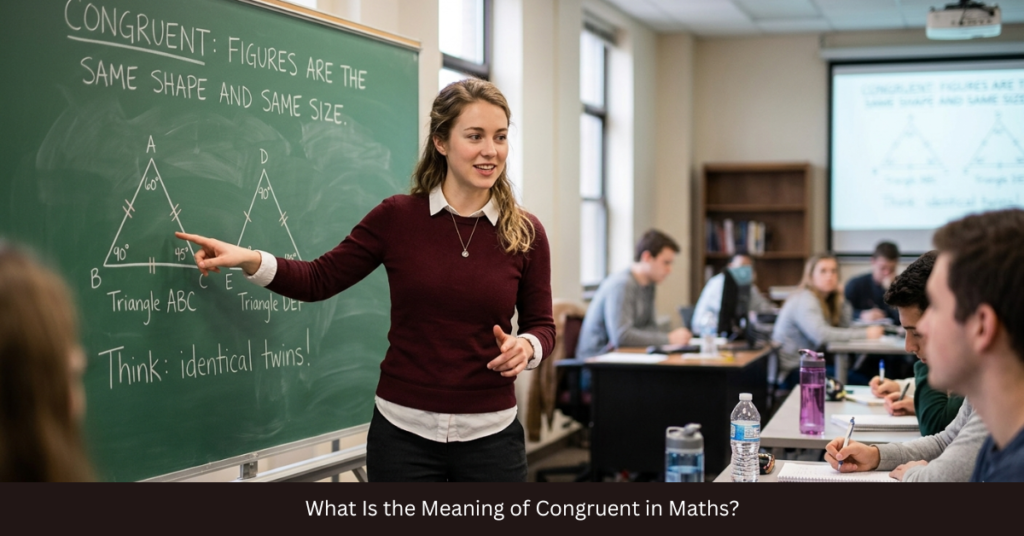

If you’ve ever come across triangles, circles, or shapes in your math class, you’ve probably heard the term congruent. But what does it really mean? In simple terms, congruent shapes are figures that are exactly the same in size and shape. Understanding this concept is essential not just for geometry but for solving problems in algebra, trigonometry, and real-world applications. Let’s break it down in an easy-to-understand way.
Definition of Congruent in Maths
In mathematics, congruent refers to figures or objects that are identical in form and dimensions. This doesn’t mean they have to be in the same position or orientation—they just need to be a perfect match in size and shape.
For example:
- Two triangles are congruent if their corresponding sides and angles are equal.
- Two circles are congruent if they have the same radius.
Symbolically, congruence is represented as:
△ABC≅△DEF\triangle ABC \cong \triangle DEF
This means triangle ABC is congruent to triangle DEF.
Key Properties of Congruent Shapes
When we say shapes are congruent, there are specific rules that confirm their congruency:
- Corresponding Sides are Equal – Every side of one shape matches exactly with the corresponding side of the other.
- Corresponding Angles are Equal – Each angle in one figure is identical to the corresponding angle in the other.
- Rigid Transformations – Congruent shapes can be rotated, flipped, or moved without changing their congruency.
Examples of Congruent Shapes
Understanding examples makes this concept much easier:
- Triangles: Two triangles with sides 5 cm, 6 cm, 7 cm and corresponding angles of 50°, 60°, 70° are congruent.
- Rectangles: Any two rectangles with the same length and width are congruent, even if one is rotated.
- Circles: Two circles with the same radius are always congruent, regardless of their position.
Congruent vs. Similar Shapes
A common question is: What’s the difference between congruent and similar shapes?
- Congruent: Shapes are exactly the same in size and shape.
- Similar: Shapes have the same shape but may differ in size.
So, all congruent shapes are similar, but not all similar shapes are congruent.
Real-Life Applications of Congruence
Congruence isn’t just a classroom concept; it’s used in everyday life and professional fields:
- Architecture & Engineering: Ensuring structural elements like beams and panels fit perfectly.
- Art & Design: Creating symmetrical patterns or repeating designs.
- Navigation & Mapping: Matching distances and angles accurately on maps.
FAQs About Congruence in Maths
Q1: How can I check if two shapes are congruent?
You can compare corresponding sides and angles. If all match, the shapes are congruent.
Q2: Can congruent shapes be in different positions?
Yes! They can be rotated, flipped, or moved, but their size and shape remain the same.
Q3: Are squares congruent to rectangles?
Only if the rectangle’s sides match the square’s sides exactly.
Q4: What is the symbol for congruence?
The symbol is “≅\cong”. For example, △ABC≅△DEF\triangle ABC \cong \triangle DEF.
Q5: Is congruence used outside geometry?
Absolutely! Fields like physics, engineering, and design frequently apply congruence concepts.
Conclusion
So, the meaning of congruent in maths boils down to one simple idea: sameness in size and shape. Recognizing congruent figures helps in solving geometry problems, creating precise designs, and understanding patterns in the real world. Next time you see two identical triangles, rectangles, or circles, you’ll know exactly why they’re called congruent!