
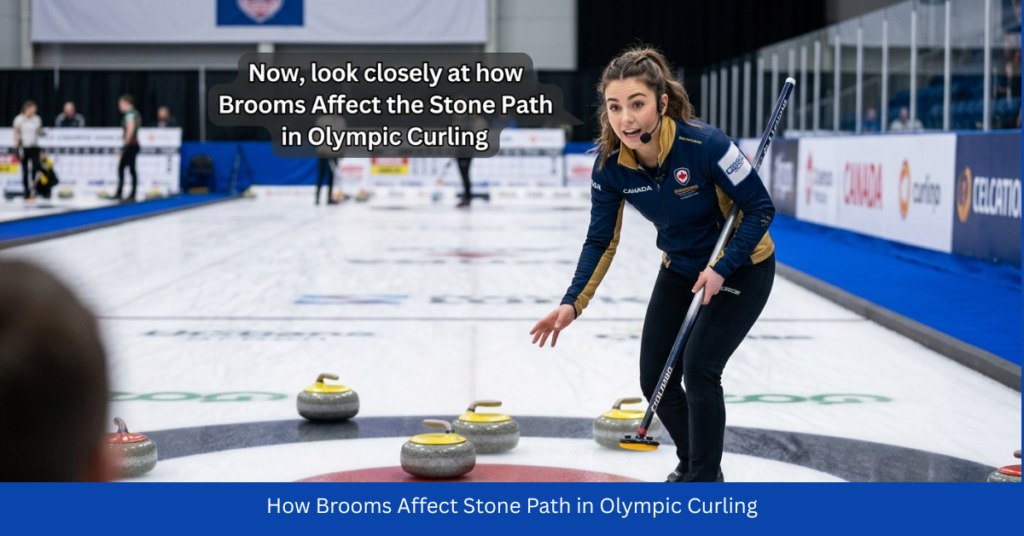

If you’ve ever watched Olympic curling, you’ve probably wondered why players furiously sweep the ice in front of a moving stone. It looks simple—but there’s serious science behind it. So, how do brooms affect the stone’s path in Olympic curling?
In short, sweeping can control the stone’s speed, direction, and final position. But the real explanation goes deeper, involving friction, ice texture, and split-second decisions by the athletes. In this guide, we’ll break it all down in a way that’s easy to understand—even if you’re new to curling.
The Basics of Curling and Stone Movement
Before diving into sweeping, it helps to understand how a curling stone behaves naturally.
When a stone is released:
- It slides over pebbled ice (small water droplets frozen on the surface)
- It rotates slightly (called the “handle”)
- It gradually slows down due to friction
- It “curls” or curves as it loses speed
Without sweeping, the stone will follow a predictable curved path based on its spin and the ice conditions.
How Do Brooms Affect the Stone’s Path in Olympic Curling?
Sweeping directly changes how the stone interacts with the ice. Players use brooms to:
- Reduce friction
- Delay the curl
- Increase the distance traveled
1. Reducing Friction on the Ice
When players sweep, they generate heat through rapid brushing. This slightly melts the ice surface, creating a thin layer of water.
Result:
- The stone glides more smoothly
- It loses less energy
- It travels farther
2. Controlling the Curl (Direction)**
One of the most fascinating aspects of curling is how sweeping affects direction.
- Sweeping keeps the stone straighter for longer
- Less friction means less grip on the ice
- The stone curls later and less sharply
This is crucial when aiming for precise shots.
3. Adjusting Speed in Real Time
Sweeping isn’t just about direction—it’s also about distance control.
Players can:
- Sweep harder to carry the stone farther
- Stop sweeping to let it slow down and curl
This makes sweeping a real-time adjustment tool during play.
The Science Behind Sweeping
The answer to how do brooms affect the stone’s path in olympic curling? lies in physics.
Key scientific factors include:
- Friction: Sweeping lowers resistance between the stone and ice
- Temperature: Brushing increases surface warmth slightly
- Pebble Ice Structure: Sweeping smooths the tiny bumps on the ice
Together, these factors create a faster, straighter path for the stone.
Types of Sweeping Techniques
Not all sweeping is the same. Elite curlers use different techniques depending on the situation.
Common techniques include:
- Power Sweeping:
Fast, aggressive strokes to maximize distance - Directional Sweeping:
Focused brushing on one side to influence curl - Light Sweeping:
Minimal effort to fine-tune speed
Each technique plays a role in controlling the stone with precision.
Communication and Team Strategy
Sweeping isn’t random—it’s guided by teamwork.
During a shot:
- The skip (team leader) calls instructions
- Sweepers respond instantly
- Decisions are based on speed, line, and target
This coordination is essential to make sweeping effective.
Common Myths About Curling Brooms
Let’s clear up a few misconceptions:
- Myth: Sweeping pushes the stone forward
- Reality: It reduces friction, not physically pushes
- Myth: Sweeping always makes the stone go straight
- Reality: It delays curl, but doesn’t eliminate it
- Myth: Anyone can sweep effectively
- Reality: It requires strength, timing, and technique
Why Sweeping Matters in Olympic-Level Curling
At the Olympic level, games are decided by centimeters. Sweeping can be the difference between:
- A perfect shot
- Missing the target entirely
That’s why teams train extensively to master sweeping—it’s just as important as delivering the stone.
FAQs
Q1: How do brooms affect the stone’s path in Olympic curling?
Sweeping reduces friction, allowing the stone to travel farther and curl less, helping players control both speed and direction.
Q2: Does sweeping really heat the ice?
Yes, but only slightly. The friction from brushing creates enough heat to form a thin water layer, reducing resistance.
Q3: Can sweeping stop a stone completely?
No, it can only influence speed and direction—not stop the stone instantly.
Q4: Why do players sweep harder sometimes?
Harder sweeping increases the effect, helping the stone travel farther or stay straighter.
Q5: Is sweeping more important than throwing?
Both are equally important. A perfect throw still needs good sweeping to achieve the desired result.
Conclusion
So, how do brooms affect the stone’s path in Olympic curling? They act as a powerful control tool, helping players fine-tune speed, reduce curl, and guide the stone precisely where it needs to go.
What looks like frantic brushing is actually a highly skilled technique backed by physics and teamwork. The next time you watch curling, you’ll see sweeping in a whole new light—not just as effort, but as strategy in motion.
If you’re curious to learn more, explore other curling techniques or dive deeper into the science behind ice sports—it’s a surprisingly fascinating world.