

You’ve probably typed “infact or in fact” at least once and wondered which one is actually correct. It’s a small detail, but getting it wrong can quietly weaken your writing—especially in emails, essays, or professional content.
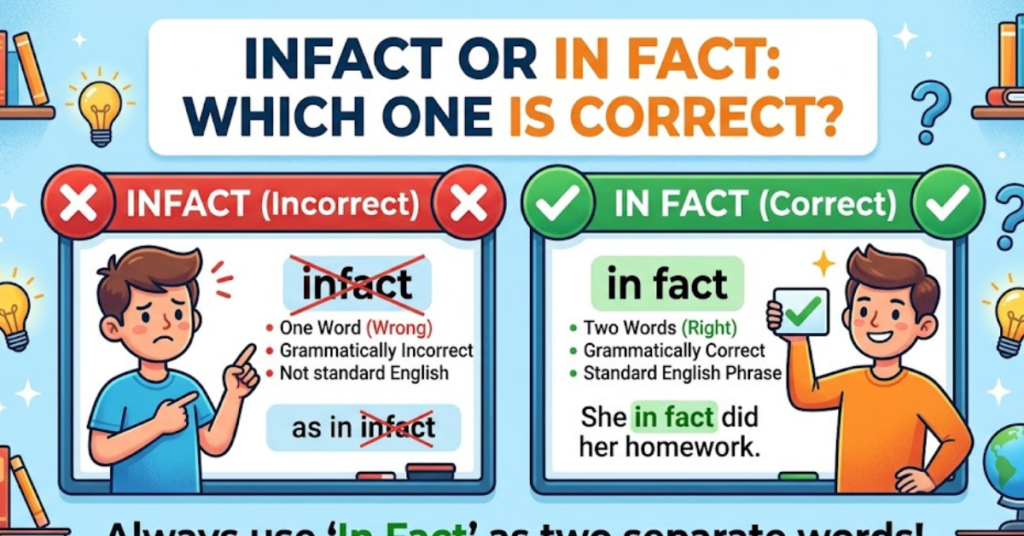
Here’s the short answer: “in fact” is correct, while “infact” is not a standard word in English.
In this guide, we’ll break down is it infact or in fact, explain why the confusion happens, and show you how to use the correct form naturally in your everyday writing.
Infact or In Fact – What’s the Difference?
Let’s clear it up right away.
- In fact = Correct (two words)
- Infact = Incorrect (not recognized in standard English)
“In fact” is a commonly used phrase that acts as a connector or emphasis tool in sentences. It helps clarify, strengthen, or even contradict a statement.
Example:
- I thought the movie would be boring. In fact, it was amazing.
On the other hand, “infact” (one word) is simply a misspelling. You won’t find it in reputable dictionaries.
Why Do People Confuse “Infact” and “In Fact”?
This confusion is surprisingly common, and here’s why:
1. Fast Typing Habits
When typing quickly, people often merge short phrases into one word without noticing.
2. Similar Word Patterns
English has many words that look similar:
- “however”
- “therefore”
So it’s easy to assume “infact” follows the same pattern.
3. Autocorrect Limitations
Some devices don’t flag “infact” as an error, which reinforces the mistake.
How to Use “In Fact” Correctly
Using “in fact” is simple once you understand its purpose. It’s mainly used in three ways:
1. To Add Emphasis
Use it to strengthen a statement.
- She is very talented. In fact, she won the competition.
2. To Clarify Information
It helps provide additional details.
- He didn’t just visit once. In fact, he stayed for a week.
3. To Contradict or Correct
Sometimes it introduces a contrast.
- I assumed it was expensive. In fact, it was quite affordable.
Grammar Tip – Is “In Fact” Always Needed?
Not always. While “in fact” is useful, overusing it can make your writing feel repetitive.
Instead of:
- The product is good. In fact, it is very useful. In fact, many people like it.
Try:
- The product is good—very useful, and widely appreciated.
Tip: Use “in fact” only when it adds clarity or emphasis.
Common Mistakes to Avoid
Here are a few errors people often make when dealing with infact or in fact:
- Writing “infact” as one word
- Overusing “in fact” in every paragraph
- Using it where no emphasis is needed
Quick Fix Checklist:
- Always write it as two words
- Read your sentence aloud—does it add value?
- Replace it if it feels unnecessary
Easy Trick to Remember
If you’re unsure about is it infact or in fact, use this simple trick:
Ask yourself:
Can I replace it with “actually” or “indeed”?
- If yes → “in fact” is correct
- If no → You might not need it at all
Examples for Better Understanding
Let’s look at correct vs incorrect usage:
Correct:
- She didn’t fail. In fact, she topped the class.
- It’s not difficult. In fact, it’s quite easy.
Incorrect:
- She didn’t fail. Infact, she topped the class.
FAQs About “Infact or In Fact”
1. Is “infact” ever correct?
No, “infact” is not a correct word in standard English. Always use “in fact.”
2. Why is “in fact” written as two words?
Because it’s a phrase, not a compound word. Each word has its own role in the sentence.
3. Can I start a sentence with “in fact”?
Yes, absolutely. It’s commonly used at the beginning of sentences for emphasis.
4. Is “in fact” formal or informal?
It works in both formal and informal writing, including essays, emails, and blogs.
5. What can I use instead of “in fact”?
You can use:
- Actually
- Indeed
- As a matter of fact
Conclusion
So, when it comes to infact or in fact, the answer is clear: “in fact” is the only correct form.
It’s a simple phrase, but using it correctly can make your writing sharper, clearer, and more professional. The next time you’re typing, take that extra second to separate the words—it makes all the difference.