
If you’ve ever typed “natzi or nazi” into a search bar, you’re not alone. It’s a common spelling confusion—but behind that simple question lies a deeply significant and serious historical topic. The correct term is “Nazi,” and it refers to one of the most infamous political movements in modern history.
In this article, we’ll clear up the spelling, explain the origins of the word, and explore its historical context—especially its connection to Nazi Party, Adolf Hitler, and World War II.
Natzi or Nazi: Which One Is Correct?
Let’s get straight to the point:
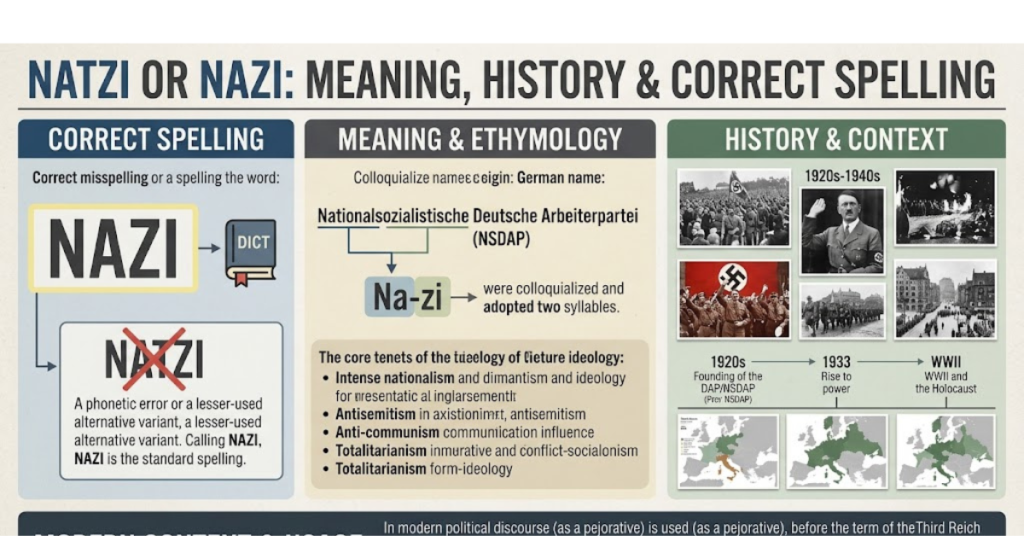
- Correct spelling: Nazi
- Incorrect spelling: Natzi
The word “Nazi” is derived from the German term “Nationalsozialist,” referring to members of the Nazi Party (National Socialist German Workers’ Party).
“Natzi” is simply a misspelling, often caused by pronunciation confusion or typing errors.
What Does “Nazi” Mean?
The term “Nazi” refers to:
- A member or supporter of the Nazi Party
- The ideology associated with extreme nationalism, authoritarian rule, and racial supremacy
- The political movement that ruled Nazi Germany from 1933 to 1945
Under the leadership of Adolf Hitler, the Nazis established a totalitarian regime that controlled nearly every aspect of life in Germany.
A Brief History of the Nazi Movement
Rise of the Nazi Party
The Nazi Party began in the early 20th century during a time of political and economic instability in Germany.
Key moments include:
- 1919: The party is founded
- 1920s: Gains popularity through propaganda and nationalist messaging
- 1933: Hitler becomes Chancellor of Germany
- 1934: Hitler consolidates power as dictator
Nazi Germany and World War II
Once in power, the Nazi regime:
- Eliminated political opposition
- Controlled media and education
- Expanded militarily across Europe
This aggressive expansion led directly to World War II, one of the deadliest conflicts in history.
The Holocaust: A Dark Chapter
One of the most horrific aspects of Nazi rule was the The Holocaust.
During this period:
- Approximately 6 million Jews were systematically murdered
- Millions of others—including Romani people, disabled individuals, and political dissidents—were persecuted and killed
This genocide remains a powerful reminder of the dangers of extremist ideologies.
Why Do People Confuse “Natzi” and “Nazi”?
There are a few simple reasons:
- Phonetic confusion: The “tz” sound appears in some German words
- Typing errors: Fast typing often leads to misspellings
- Lack of familiarity: Not everyone knows the historical term
Despite this, “Nazi” is the only correct and recognized spelling in English and historical contexts.
Modern Usage of the Word “Nazi”
Today, the word “Nazi” is used in two main ways:
1. Historical Context (Correct Use)
Referring to:
- The Nazi Party
- Nazi Germany
- Events like World War II and The Holocaust
2. Informal/Slang Use (Be Careful)
Sometimes used casually (e.g., “grammar nazi”), but this can be offensive or insensitive due to the term’s historical weight.
Key Takeaways
- “Nazi” is the correct spelling; “natzi” is incorrect
- The term is linked to a significant and tragic period in world history
- Understanding the word helps avoid misinformation and misuse
- The topic should always be approached with accuracy and respect
FAQs About Natzi or Nazi
1. Is “natzi” ever correct?
No, “natzi” is always a misspelling. The correct term is “Nazi.”
2. What does Nazi stand for?
It comes from “Nationalsozialist,” meaning National Socialist.
3. Who was the leader of the Nazis?
Adolf Hitler led the Nazi regime.
4. Why is the term sensitive?
Because it is associated with The Holocaust and widespread human suffering.
5. Can “Nazi” be used casually?
It’s best to avoid casual use, as it can be offensive or trivialize serious historical events.
Conclusion
When it comes to “natzi or nazi,” the answer is clear: “Nazi” is the correct spelling. However, beyond simply getting the spelling right, this word carries immense historical weight and significance. In fact, it is closely tied to one of the darkest chapters in human history, particularly the actions and ideology of the Nazi Party.
Therefore, understanding its meaning isn’t just a matter of language accuracy; rather, it is about acknowledging the past and the profound consequences associated with it. Moreover, by learning about this term in its proper historical context, we can better grasp the events that shaped the modern world. At the same time, this awareness helps ensure that such tragedies are neither ignored nor repeated.
In addition, if you’re interested in exploring further, you should consider turning to trusted historical sources. For example, books, documentaries, and academic articles can provide deeper insights and a more nuanced perspective. Ultimately, by continuing to educate ourselves, we not only expand our knowledge but also contribute to preserving the lessons of history for future generations.