
Have you ever paused mid-sentence wondering whether to write oversite or oversight? You’re not alone. The confusion around Oversite vs Oversight is surprisingly common, especially in professional writing where accuracy matters.
In this guide, we’ll break down the meaning, usage, and key differences between these two terms—so you never second-guess yourself again. We’ll also explore how oversite vs oversight supervision fits into real-world contexts like business, management, and everyday communication.
Oversite vs Oversight: What’s the Difference?
At first glance, these words look nearly identical—but only one is correct in standard English.
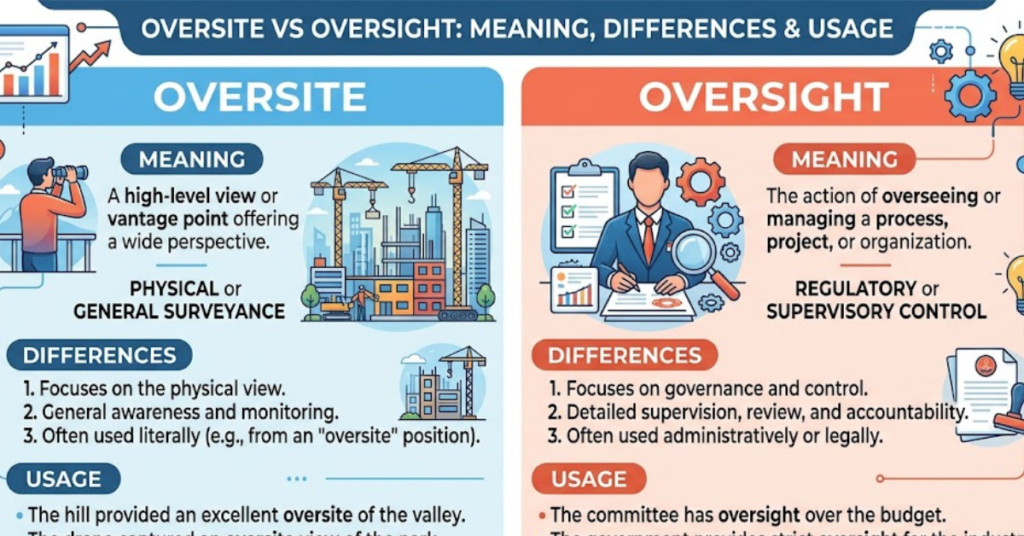
Oversight (Correct Word)
Oversight is a real and widely used English word with two main meanings:
- Supervision or management
- Example: The manager has oversight of the entire project.
- An unintentional mistake
- Example: Missing that detail was an oversight.
Oversite (Common Mistake)
Oversite is generally considered a misspelling of “oversight.” It is not recognized as a standard word in most dictionaries.
In rare cases, “oversite” could be interpreted as “over a site” (like in construction), but this usage is extremely uncommon and not grammatically standard.
Why Do People Confuse Oversite vs Oversight?
The confusion usually comes down to pronunciation and typing habits. When spoken, oversight can sound like “oversite,” especially in fast conversations.
Here are a few reasons for the mix-up:
- Similar sound and spelling
- Typographical errors (especially on mobile)
- Lack of awareness of the correct form
Bottom line: “Oversight” is always the correct choice in professional and academic writing.
Oversight in Supervision and Management
When discussing oversite vs oversight supervision, the correct term is always oversight.
What Does Oversight Mean in Supervision?
In a professional context, oversight refers to:
- Monitoring tasks and performance
- Ensuring rules and standards are followed
- Providing guidance and accountability
Example in Real Life
- The board provides oversight to ensure the company follows regulations.
- Effective oversight improves team productivity and reduces errors.
Key Responsibilities of Oversight
- Reviewing progress
- Managing risks
- Ensuring compliance
- Supporting decision-making
Oversight vs Similar Words
To better understand “oversight,” it helps to compare it with related terms:
| Word | Meaning | Example |
| Oversight | Supervision or mistake | She has oversight of operations. |
| Supervision | Direct management | He supervises the staff daily. |
| Management | Overall control and planning | Management approved the plan. |
| Negligence | Failure to take proper care | The issue arose from negligence. |
Notice how oversight can mean both control and a mistake—context matters.
Common Examples of Oversight
Here are some everyday examples to make things clearer:
1. Oversight as Supervision
- Government agencies provide oversight to public services.
- The teacher has oversight of student activities.
2. Oversight as a Mistake
- Forgetting the deadline was an oversight.
- The error happened due to a simple oversight.
Tips to Remember the Difference
If you’re still unsure about Oversite vs Oversight, here’s an easy trick:
Think of “oversight” = “seeing over something”
That naturally connects to supervision or noticing mistakes.
Quick Memory Tips
- Use oversight in all cases
- Avoid “oversite” (it’s almost always wrong)
- Double-check spelling in formal writing
When Does Oversight Matter Most?
Correct usage is especially important in:
- Business reports
- Academic writing
- Legal documents
- Emails and professional communication
Using “oversite” instead of “oversight” can make your writing look less polished and credible.
FAQs
1. Is “oversite” ever a correct word?
No, “oversite” is not considered standard English. It’s almost always a misspelling of “oversight.”
2. What does “oversight” mean in simple terms?
It can mean either supervision or a small mistake, depending on context.
3. How do you use oversight in a sentence?
- She has oversight of the project.
- The delay was due to an oversight.
4. What is oversight in management?
Oversight in management refers to monitoring operations, ensuring compliance, and guiding decision-making.
5. Why is “oversite vs oversight supervision” confusing?
Because people mistakenly use “oversite” instead of “oversight,” especially in professional contexts involving supervision.
Conclusion
Understanding Oversite vs Oversight is simpler than it seems once you know the rule:
“Oversight” is correct. “Oversite” is a mistake.
Whether you’re writing an email, preparing a report, or discussing oversight supervision, using the correct term instantly boosts your credibility and clarity.