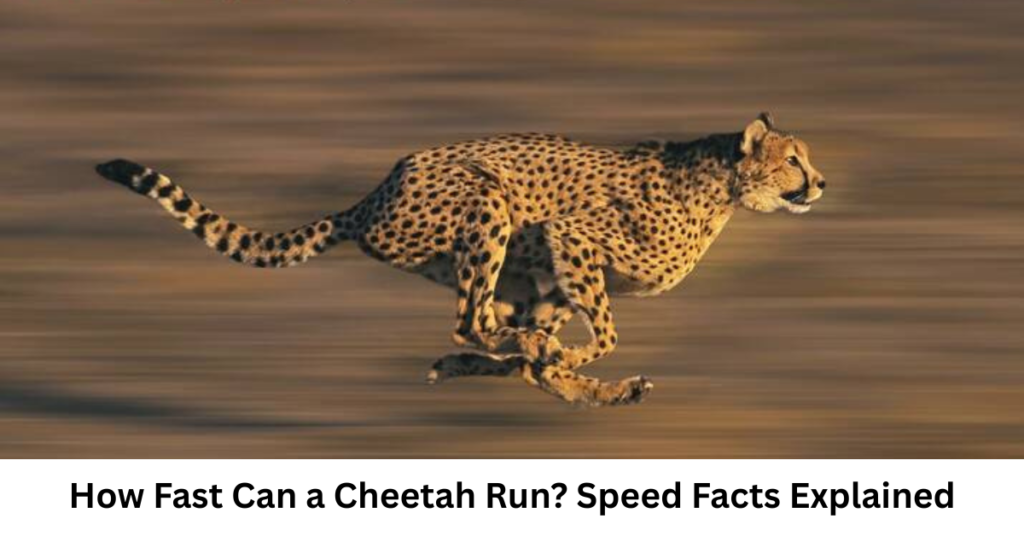

When people talk about speed in the animal kingdom, one question always comes up: how fast can a cheetah run? The cheetah is widely known as the fastest land animal on Earth, capable of breathtaking bursts of speed that leave other predators far behind.
In this article, we’ll break down its top speed, acceleration, and hunting abilities in a simple and engaging way. If you’ve ever wondered what makes this big cat such an incredible sprinter, you’re in the right place.
How fast can a cheetah run in km/h and mph?
The cheetah’s speed is nothing short of extraordinary. On average, a cheetah can reach:
- Top speed: 80–98 km/h (50–61 mph)
- Acceleration: From 0 to 100 km/h in about 3 seconds
- Sprint duration: Usually 20–30 seconds only
So, when asking how fast can a cheetah run, the answer is simple: fast enough to outrun almost every land animal on Earth in a short chase.
However, this speed is not built for long distances. Cheetahs rely on short, explosive bursts rather than endurance running.
What makes a cheetah the fastest land animal?
The cheetah’s body is perfectly designed for speed. Several physical features contribute to its incredible performance:
Lightweight body structure
Cheetahs have a slim, aerodynamic frame that reduces drag while running.
Long legs and flexible spine
Their long limbs and highly flexible spine allow them to stretch and cover more ground in each stride.
Large nasal passages and lungs
This helps them take in more oxygen during high-speed chases.
Semi-retractable claws
Unlike other cats, cheetahs use their claws like running spikes for better grip.
All these adaptations work together to make how fast can a cheetah run a truly impressive biological achievement.
How cheetahs use their speed for hunting
Speed isn’t just for show—it’s a survival tool. Cheetahs rely on quick bursts to catch prey like gazelles and impalas.
A typical hunt involves:
- Spotting prey from a distance
- Sneaking closer quietly
- Sprinting at full speed in a short chase
- Tripping or suffocating the prey quickly
Even though they are extremely fast, cheetahs must end hunts quickly because they overheat easily after intense sprinting.
Limitations of a cheetah’s speed
While it’s fascinating to learn how fast can a cheetah run, it’s equally important to understand its limits:
- Can only maintain top speed for 20–30 seconds
- Needs long rest after a sprint
- Not strong enough to defend kills from larger predators
- High energy cost during each chase
This is why survival for cheetahs is a constant balance between speed and energy conservation.
Cheetah speed compared to other animals
To put things into perspective:
- Cheetah: up to 98 km/h
- Lion: around 80 km/h (short bursts)
- Horse: up to 88 km/h
- Greyhound dog: around 72 km/h
Even among fast animals, the cheetah clearly dominates in acceleration and peak speed.
FAQs about cheetah speed
1. How fast can a cheetah run at full speed?
A cheetah can reach up to 80–98 km/h, making it the fastest land animal.
2. Can a cheetah maintain its top speed for long?
No, it can only sprint at top speed for about 20–30 seconds.
3. Why is a cheetah so fast?
Its lightweight body, flexible spine, and powerful muscles help it achieve extreme speed.
4. Is a cheetah faster than a lion?
Yes, in short bursts, a cheetah is faster than a lion.
5. How does a cheetah stop after running so fast?
It slows down gradually and needs rest to recover body temperature and oxygen levels.
Conclusion
So, how fast can a cheetah run? In simple terms, it’s the fastest land sprint you’ll ever see in nature—reaching nearly 100 km/h in seconds. But what makes it even more fascinating is not just the speed itself, but how perfectly the cheetah is built for short, powerful chases.
If you’re interested in wildlife wonders like this, exploring other fast animals or survival adaptations can be just as exciting.