

You know that moment when you quietly walk across your room and creeeak—the floor gives you away? It’s frustrating, especially when the noise seems to get louder at night. If you’re wondering how to fix creaky floorboards, you’re definitely not alone.
Creaking floors are one of the most common household issues in both old and new homes. The good news? They’re usually easy to fix once you understand what’s causing them. In most cases, it’s just wood rubbing against wood, loose nails, or gaps forming over time.
In this guide, you’ll learn practical, DIY-friendly ways to stop floorboard squeaks for good—without tearing your whole floor apart.
Why Do Floorboards Creak in the First Place?
Before jumping into repairs, it helps to understand the root cause of the noise.
Common reasons behind creaky floors:
- Loose nails or screws
- Wood shrinking due to temperature changes
- Subfloor movement
- Friction between boards
- Age-related wear and tear
- Improper installation
Wood is a natural material—it expands in heat and contracts in cold. Over time, this movement creates gaps that lead to squeaking sounds when pressure is applied.
How to Fix Creaky Floorboards (Step-by-Step Methods)
There isn’t just one solution. The best method depends on whether you can access the floor from above or below.
1. Fixing Creaky Floorboards from Above
If you don’t have access to the underside of the floor, don’t worry. You can still fix the issue from the top.
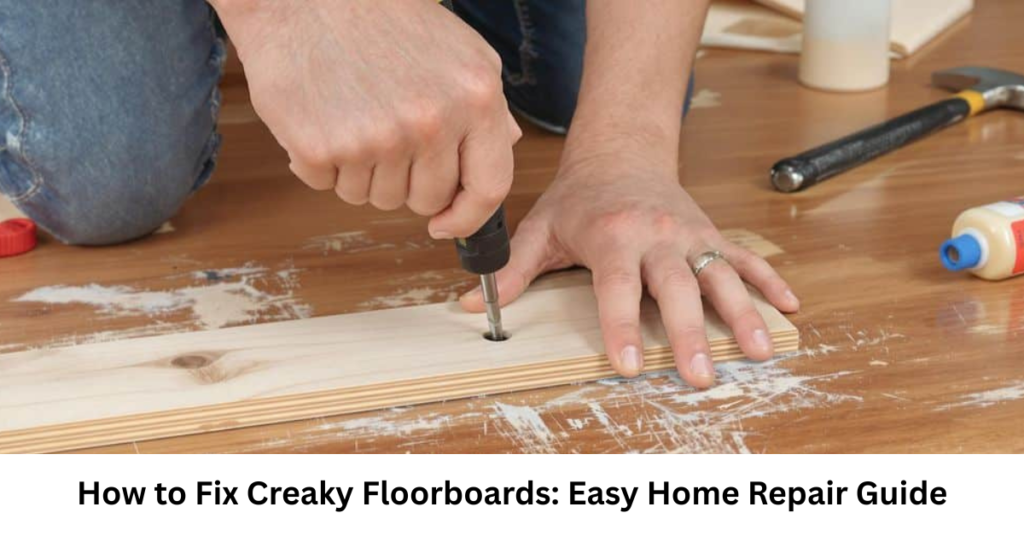
Tighten loose boards with screws
This is one of the most effective DIY solutions.
Steps:
- Locate the squeaky area by walking slowly
- Mark the exact spot
- Drill a small pilot hole
- Insert a screw into the joist beneath
- Cover with wood filler or putty
This method pulls the board tightly against the joist, reducing movement and noise.
Use powdered graphite or talcum powder
If the squeak is caused by friction between boards:
- Sprinkle powder into the gaps
- Sweep it in so it settles inside
- Walk over the area to distribute it
This reduces friction and quiets minor squeaks instantly.
Fill gaps with wood filler
For visible cracks or loosened joints:
- Clean the gap properly
- Apply wood filler
- Let it dry and sand smooth
This won’t fix structural movement, but it helps with light squeaking and appearance.
2. Fixing Creaky Floorboards from Below (Best Method)
If you have access to the underside (like a basement or crawl space), you can fix the problem more permanently.
Reinforce with wood blocks
This is one of the strongest repair methods.
Steps:
- Identify the squeaky joist area
- Attach a small wooden block under the board
- Use screws to secure it tightly
This stops movement completely and strengthens the structure.
Apply construction adhesive
A simple but powerful solution:
- Apply adhesive between joist and board
- Press firmly
- Support it until it dries
This reduces long-term movement and noise.
Add shims to fill gaps
Sometimes, floorboards creak because they’re slightly loose.
- Insert thin wood shims between joist and floorboard
- Tap gently until tight
- Secure with glue or nails
This is especially useful for older homes.
3. Quick Fixes for Immediate Relief
If you’re not ready for full repairs, try these temporary solutions:
- Place rugs or carpets over noisy areas
- Use furniture to distribute weight
- Apply baby powder for minor squeaks
- Avoid heavy stepping on loose spots
These won’t solve the root problem but can reduce noise quickly.
Preventing Floorboards from Creaking Again
Once you fix the issue, prevention is key.
Simple prevention tips:
- Maintain stable indoor humidity
- Avoid excessive water exposure
- Check and tighten screws periodically
- Use proper underlayment during renovations
- Choose quality wood materials for flooring
Wood stability depends heavily on environment control, so small habits make a big difference.
When Should You Call a Professional?
DIY fixes work for most cases, but sometimes you need expert help.
Call a professional if:
- The entire floor is uneven
- Creaking is extremely widespread
- You suspect structural damage
- Subfloor is damaged or rotting
Ignoring serious issues can lead to bigger (and more expensive) repairs later.
FAQs About Fixing Creaky Floors
1. Why do my floorboards creak more at night?
Temperature drops at night cause wood to contract slightly, increasing friction and noise.
2. Can creaky floors be fixed without removing carpet?
Yes, you can use screw-based methods or adhesive techniques depending on access.
3. Are creaky floors a sign of damage?
Not always. Most of the time it’s normal wear, not structural damage.
4. Does WD-40 help fix squeaky floors?
It may temporarily reduce noise, but it’s not a long-term solution.
5. How long does it take to fix creaky floorboards?
Small fixes take 10–30 minutes, while deeper repairs may take a few hours.
Conclusion: Quiet Floors Are Easier Than You Think
Now you know exactly how to fix creaky floorboards using simple, practical methods. Most squeaks come from loose boards, friction, or minor structural movement—and they’re usually easy to handle with basic tools.
Whether you tighten screws, add adhesive, or use quick fixes like powder, the key is identifying the cause first. Once you do that, restoring a quiet, stable floor becomes surprisingly straightforward.
If your floors are still noisy after trying these methods, it might be worth exploring deeper structural inspection—but in most cases, a little DIY effort goes a long way.