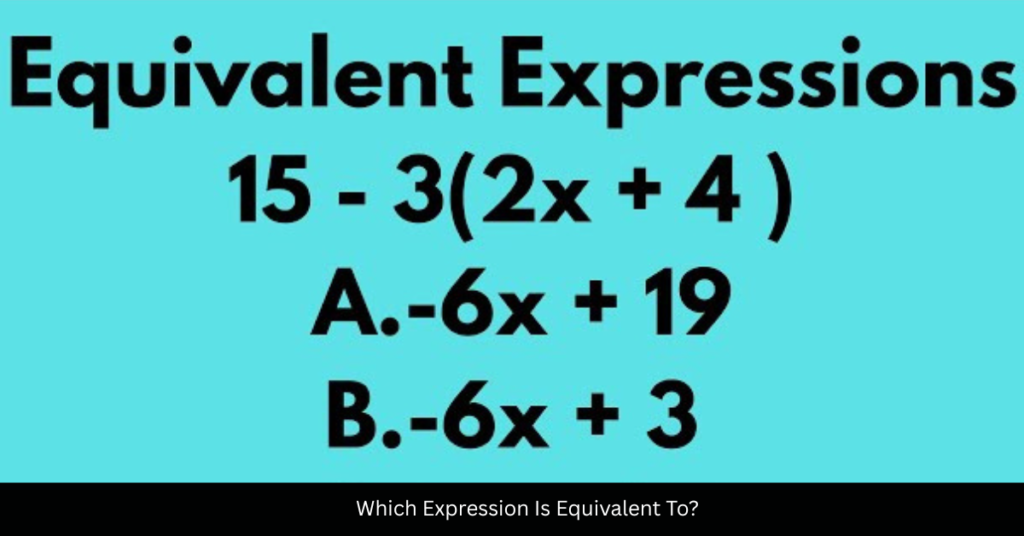

Ever looked at a math problem and wondered, which expression is equivalent to ? You’re not alone. This is one of the most common types of algebra questions students face, and it often feels trickier than it actually is.
In reality, equivalent expressions are just different ways of writing the same value. Once you understand the rules and patterns, solving these questions becomes much easier—and even a bit fun. In this guide, we’ll break everything down step by step so you can confidently tackle any variation of this problem.
What Does “Equivalent Expression” Mean?
An equivalent expression is a mathematical expression that has the same value as another, even if it looks different.
Simple Examples:
- 6+8=146 + 8 = 146+8=14 → Equivalent to 10+410 + 410+4
- 2(x+3)2(x + 3)2(x+3) → Equivalent to 2x+62x + 62x+6
- 3a+3a3a + 3a3a+3a → Equivalent to 6a6a6a
So when you see a question like which expression is equivalent to ?, you’re being asked to find another form that gives the same result.
Key Rules to Find Equivalent Expressions
Understanding a few core rules makes everything easier.
1. Use the Distributive Property
This is one of the most important tools in algebra.
Formula:
a(b+c)=ab+aca(b + c) = ab + aca(b+c)=ab+ac
Example:
- 2(4+5)=2×4+2×5=8+10=182(4 + 5) = 2×4 + 2×5 = 8 + 10 = 182(4+5)=2×4+2×5=8+10=18
2. Combine Like Terms
Like terms have the same variables and powers.
Examples:
- 6a+2a=8a6a + 2a = 8a6a+2a=8a
- 12xy−7xy=5xy12xy – 7xy = 5xy12xy−7xy=5xy
- 8p+14p=22p8p + 14p = 22p8p+14p=22p
3. Simplify Fractions and Powers
Expressions often look complicated because they aren’t simplified.
Examples:
- 216÷1,728=18216 ÷ 1,728 = \frac{1}{8}216÷1,728=81
- 24=162^4 = 1624=16
4. Factor Expressions
Sometimes you need to reverse the process.
Example:
- 6x+12=6(x+2)6x + 12 = 6(x + 2)6x+12=6(x+2)
Solving Different Types of Questions
Let’s explore common variations you might encounter.
Which Expression Is Equivalent To ? Assume x ≠ 0
When variables are involved, simplifying is key.
Example:
6x2x\frac{6x}{2x}2x6x
Step-by-step:
- Cancel xxx (since x≠0x ≠ 0x=0)
- 6÷2=36 ÷ 2 = 36÷2=3
Equivalent expression: 3
Which Expression Is Equivalent To ? a. b. c. d.
Multiple-choice questions test your ability to compare.
Example:
2(3+x)2(3 + x)2(3+x)
Options:
- a. 6+x6 + x6+x
- b. 3+2×3 + 2x3+2x
- c. 6+2×6 + 2x6+2x
- d. 5x5x5x
Correct answer: c. 6+2×6 + 2x6+2x
If , Which Expression Is Equivalent To ?
These questions require substitution.
Example:
If k=2k = 2k=2, find equivalent expression of:
3k+43k + 43k+4
Solution:
- 3(2)+4=6+4=103(2) + 4 = 6 + 4 = 103(2)+4=6+4=10
Which Expression Is Equivalent To ? –8
Negative numbers can be tricky.
Example:
4−124 – 124−12
Solution:
- 4−12=−84 – 12 = -84−12=−8
Which Expression Is Equivalent To ? 6 + 8
This is a basic simplification.
6+8=146 + 8 = 146+8=14
Equivalent expressions could be:
- 10+410 + 410+4
- 7×27 × 27×2
Common Mistakes to Avoid
Even simple problems can go wrong if you’re not careful.
Watch out for:
- Forgetting to distribute properly
- Combining unlike terms
- Ignoring negative signs
- Not simplifying fully
Quick Tips to Solve Faster
- Always simplify step by step
- Double-check your calculations
- Look for patterns in answer choices
- Practice regularly with different examples
FAQs
1. What does equivalent mean in math?
It means two expressions have the same value, even if they look different.
2. How do you check if expressions are equivalent?
Simplify both expressions. If they result in the same value, they are equivalent.
3. Why are equivalent expressions important?
They help simplify problems, solve equations, and understand algebra better.
4. Can equivalent expressions look completely different?
Yes, they can look very different but still represent the same value.
5. What is the easiest way to learn this topic?
Practice using distributive property, combining like terms, and solving examples daily.
Conclusion
Understanding which expression is equivalent to ? is a fundamental algebra skill that becomes easier with practice. By mastering basic rules like distribution, combining like terms, and simplification, you can solve even complex problems with confidence.
The key takeaway? Different expressions can represent the same value—your job is simply to recognize how. Keep practicing, and soon these questions will feel second nature.