
Ever looked at two triangles and wondered how you can confidently say they are exactly the same shape and size? That’s where the SAS (Side-Angle-Side) congruence rule comes in. If you’re asking which pair of triangles can be proven congruent by SAS?, you’re already on the right track to mastering one of the most important concepts in geometry.
In simple terms, SAS tells us that if two sides and the included angle of one triangle match those of another triangle, then the two triangles are congruent. Let’s break this down in a clear and practical way so you can easily recognize when SAS applies.
What Is SAS Congruence in Geometry?
SAS stands for Side-Angle-Side. It is one of the fundamental rules used to prove triangle congruence.
SAS Rule Explained:
Two triangles are congruent if:
- Two sides of one triangle are equal to two sides of another triangle
- The included angle (the angle between those two sides) is also equal
This rule helps us confirm that two triangles are identical in shape and size without measuring every side or angle.
Understanding Which Pair of Triangles Can Be Proven Congruent by SAS?
Let’s directly address the key question: which pair of triangles can be proven congruent by SAS?
The answer is simple in principle but depends on matching transformations and equal measurements.
The Correct Type of Triangle Pair:
A pair of triangles can be proven congruent by SAS if:
- They have two corresponding sides equal
- The included angle between those sides is equal
Now let’s connect this to real-world transformations you often see in geometry problems.
Triangle Pairs and Transformations That Satisfy SAS
In many questions, triangles are shown after transformations like reflection or rotation. These transformations help preserve side lengths and angles, making SAS applicable.
1. Reflected Triangles (Across a Line)
When a triangle is reflected across a line:
- Side lengths remain unchanged
- Angle measures remain unchanged
- The shape is mirrored but identical
So, if a triangle is reflected across a line to form another triangle, they can be proven congruent using SAS as long as two sides and the included angle match.
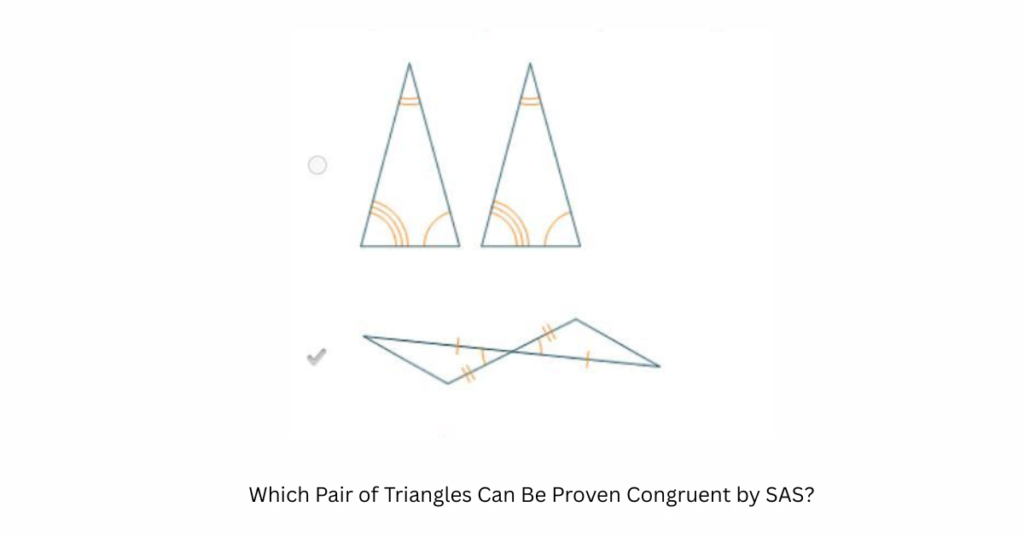
This directly answers one version of which pair of triangles can be proven congruent by SAS? 2 identical triangles are shown. the triangle is reflected across a line to form the second triangle.
2. Rotated Triangles (90 Degrees)
Rotation is another rigid transformation.
When a triangle is rotated (for example, 90 degrees):
- The shape does not change
- Side lengths remain equal
- Angles remain identical
Therefore, triangles formed by rotation also satisfy SAS conditions if the two sides and included angle correspond.
This applies to cases like:
2 identical triangles are shown. the triangle is rotated 90 degrees to form the second triangle.
3. Reflection + Rotation Combination
Sometimes a triangle is:
- First reflected
- Then rotated
Even after multiple rigid transformations:
- The triangle remains congruent to its original form
- No distortion occurs
So, SAS still applies because the key measurements (two sides and included angle) are preserved.
This matches situations like:
2 identical triangles are shown. the triangle is reflected across a line and then rotated to form the second triangle.
4. Translation or Shifted Triangles
Even if a triangle is moved:
- No change in side lengths
- No change in angles
These are also congruent by SAS if the required side-angle-side match is present.
Example scenario:
2 identical triangles are shown. the triangle is rotated up and to the left 90 degrees to form the second triangle.
Key Conditions for SAS Congruence
To quickly identify whether SAS applies, check:
- ✔ Two corresponding sides are equal
- ✔ The angle between those sides is equal
- ✔ The triangles are rigid transformations (not resized)
If all three are true, the triangles are congruent by SAS.
Common Mistakes Students Make
Assuming any similar triangle is congruent
Similarity does not guarantee equal size.
Ignoring the included angle
SAS only works if the angle is between the two known sides.
Confusing SAS with ASA or SSS
Each rule has its own condition—mixing them leads to errors.
Real-Life Understanding of SAS
Think of SAS like building two identical paper models:
- You use two sticks (sides)
- You fix the angle between them
- If both setups match, the triangles are identical
That’s exactly how SAS works in geometry proofs.
FAQs
1. What does SAS stand for in triangles?
SAS stands for Side-Angle-Side, a rule used to prove triangle congruence.
2. which pair of triangles can be proven congruent by sas?
Any pair where two sides and the included angle are equal between the triangles.
3. Do reflections and rotations preserve SAS congruence?
Yes, both are rigid transformations that preserve side lengths and angles.
4. Can triangles be congruent if only angles match?
No, matching only angles proves similarity, not congruence.
5. Why is SAS important in geometry?
It allows us to prove triangles are identical without measuring all sides.
Conclusion
So, when we ask which pair of triangles can be proven congruent by SAS?, the answer always comes down to one simple idea: two sides and the included angle must match exactly. Whether the triangle is reflected, rotated, or shifted, the SAS rule still holds as long as those conditions are satisfied.
Understanding SAS helps you quickly solve geometry problems and recognize congruent shapes in diagrams with confidence. If you’re practicing, focus on identifying the included angle first—that’s the key to mastering SAS proofs.